THE LEAD / HISTORY & RETRIEVAL TESTED
Your coding agents
remember everything.
Good luck finding any of it.
Spaghetti builds a local search index from coding-agent history. We fed it three bounded real Codex sessions and discovered both a much better way to browse the past and a good reason not to uninstall `rg` just yet.
Read the full hands-on review ↗We actually used it against a controlled fixture and a bounded copy of real Codex history. The private contents stay private.
1,007 SEGMENTS 988 INDEXED
STARTUP 94 ms
Machine Folklore / COMPUTING HISTORY
EDITORIAL ART / NOT EVIDENCE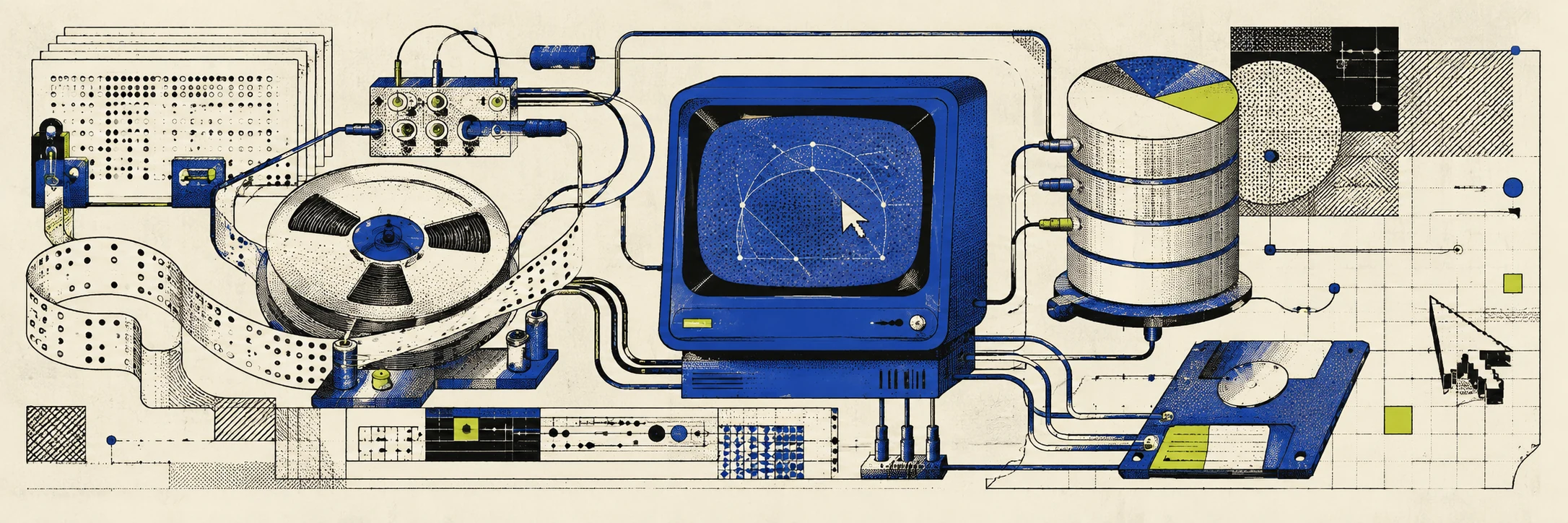
FEATURE / AI-NATIVE COMPUTING
The Anvil: What If AI Didn't Have to Use Computers the Way We Do?
Anvil is a one-kilobyte experimental machine with no shell, files or escape hatch. The aim is to discover whether an AI can work more reliably when the machine exposes exact capabilities, executes transactionally and returns measured evidence instead of human-oriented computer folklore.
Enter the one-kilobyte universe ↗FEATURE / COORDINATION & AI SYSTEMS
When AI Work Needs a Place to Live
An agent can make a plan in seconds. The harder question is what happens to that promise when a worker stalls, a lease expires, or the outside world gives an uncertain answer. Resolve01 is building the durable coordination layer for that middle ground.
Read how Resolve keeps commitments ↗COLUMN / LANGUAGE & AI
Please Stop Making AI Sound So Fucking Uncool
Artificial intelligence may be the strangest technology in public life. Its vocabulary increasingly sounds like it was approved by a committee at an airport hotel. Vibe coding, agentic AI, digital coworkers and the rest are not harmless cringe: bad language flattens useful distinctions and makes new ideas harder to think about.
Read the linguistic autopsy ↗FEATURE / AI & OPEN INNOVATION
The Prize Is the Cheapest Part of a Hackathon
Hackathons do more than produce winners. They produce a field of experiments, ideas, pain points and prototypes. AI makes that field cheaper to analyse, while some competition rules explicitly permit internal research, AI training or commercial reuse. That does not prove theft. It does mean entrants should know exactly what they are giving away.
Read the investigation ↗ESSAY / HUMAN–AI COLLABORATION
The Thinking Surface
Generative AI proved that machines can produce. The more interesting problem now is how to build systems that remove dead cognitive labour without removing the human thinking, judgement and creative struggle that give work meaning.
Read the manifesto ↗ESSAY / AI TESTING & AUTHORITY
The Bat Needs a Collar
An encounter with an automated safety warning raises a bigger architectural question: as AI testing tools grow autonomous and adversarial, how should each run carry the scope of its authority—and prove the bounds were enforced?
Read the essay ↗Recent reviews & scouting notes
The full index ↗01 / tracelet SCOUTED
Watch the agent. Not the spinner.
A local view into the calls, prompts and pauses behind an AI run.
↗02 / outl SCOUTED
Your notes. Still your files.
An outliner that puts plain Markdown at the centre of the bargain.
↗03 / chrondb SCOUTED
What if your database could rewind?
Git-style history is a compelling idea. Compatibility is the harder question.
↗Latest from Radar / fresh signals
Open the observatory ↗A screen that behaves more like an instrument than a television
Patternflow is an open-source 8,192-pixel LED synthesizer whose four knobs alter code-generated images in real time. The clever bit is not the LEDs; it is treating visual algorithms as playable, shareable patches.
↗DESK REVIEW / Agent infrastructureBrowser agents may be paying a round-trip tax nobody bothered to count
Public Browser drives a real Chrome profile directly over CDP, but its more interesting claim is architectural: fewer agent-tool round trips can matter more than shaving bytes from each browser snapshot.
↗SPOTTED / AI infrastructureWhat if an AI answer had to fit through Rust's type system first?
s1-rs is a tiny, very new experiment in turning model decisions into typed Rust values with confidence gates. It is barely born, but the design points toward a useful boundary between probabilistic judgement and deterministic software.
↗FRESH SIGNALS / FRONTIER SOFTWARE
What if “done” had to be proved?
Atlas is trying to turn “please don't quietly move the goalposts” from an instruction into software. Its Goal Contracts and evidence gates are only partly wired today, but the idea is interesting enough to deserve attention before the product is finished.
Task completion becomes a state that software can check.
Read the Fresh Signal ↗29 focused tests passed. The live agent loop remains unfinished.
Present gates ≠ complete productNOTEBOOK / SCOUT NOTE READY
TermAI looked interesting. Windows disagreed.
TermAI promises a terminal-native assistant with local sessions, branching, Git helpers and several provider paths. We never reached any of that. On our Windows bench, the current source build stopped at the compiler.
Read the build-blocked note ↗THE OVERLOOKED
Why isn’t
this famous?
Good software doesn’t always have a marketing department.
mcp: a protocol meets the command line ↗SMALL FOLLOWING. OPEN QUESTIONS.
Under 500★
From our first scouting list. Star counts are discovery snapshots, not quality scores or live totals.
pad.local10★ at discovery ↗GitDesktop175★ at discovery ↗jbundle179★ at discovery ↗ODDWARE / FIELD NOTE 001
A desk that refuses to be a window.
pad.local turns the desktop into an infinite canvas for editors, terminals and browsers. It may be a brilliant working surface, or one more map to maintain. That is exactly the sort of experiment we like finding.
Inspect the oddball ↗TOOLGLASS LAB / NOTEBOOK 001
A claim is where we start.
Evidence is where we’re going.
Three pieces now carry distinct evidence: one tested, one inspected with focused harness results, and one blocked before launch. Eight seeded projects remain clearly labelled scouting notes.
How we review software ↗